

Have you found the perfect job, and now need to make the perfect resume? Don’t stress, we got all the tools you need to make a resume that will truly stand out from the rest. These 11 resume building tips come from over recruiters who have viewed more than 1,000 resume, and know all about spotting exactly who employers want to hire.
11 resume building tips
1. Choose appropriate fonts and colors.
When submitting your resume for a role, it’s tempting to want yours to stand out above the rest. After all, you don’t know how many resumes the recruiter will be reading or whether other applicants will have more experience or better qualifications than you. But making your resume stand out with a quirky font or bold color is not the answer.
Recruiters are looking for fonts that are easy to scan so that they can catch the highlights from a brief glance. Sans serif fonts such as Arial, Calibri or Helvetica are good choices for printed resumes while digital resumes look best in serif fonts such as Times New Roman, Book Antiqua or Garamond. As a general rule, fonts should be black and bolded when highlighting relevant titles or subtitles.
When it comes to adding color accents to your resume, most recruiters prefer calming neutral tones and pastel colors such as pale greens and taupe’s as it helps keep the document easy to read. There are a few exceptions to this such as creative roles whereby bright colors are encouraged and formal industries where dark blues and greens are acceptable.
2. Double-check your contact information.
This is a common mistake that many job seekers fall foul of, having the wrong contact information. If you have been in your existing role for a length of time, then the chances are that you will have changed your email address or contact number during those months or years. Scan your contact information to make sure there are no accidental typos (curse you autocorrect) and that it is fully up to date.
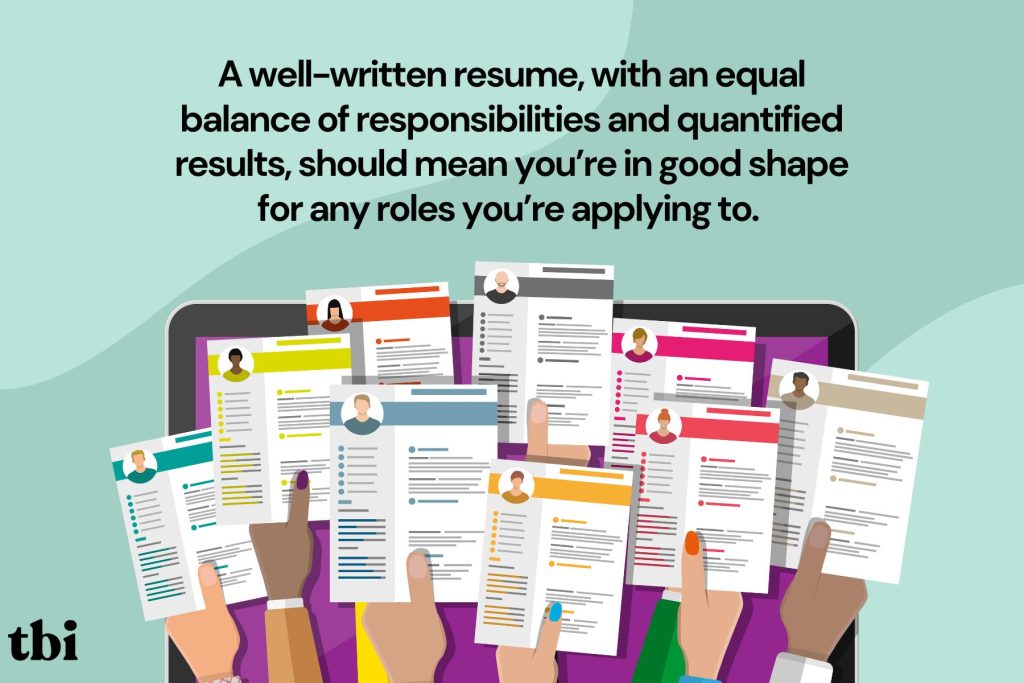
3. Try to mention achievements over responsibilities when possible.
When writing our resumes, we’re often caught in the trap of explaining our previous roles and the responsibilities that came along with them. But if you are applying for a similar role or a role within the same industry the chances are that the recruiter is already well aware of the job role and doesn’t need a blow-by-blow account from you.
So instead of filling your resume with information they already know, try to mention achievements rather than just listing the responsibilities. Manage a team of 20 people? Great, what did you achieve together with that team? Responsible for project managing? OK so what was your most successful project? Use the space in your resume to show off, not just to inform.
4. Only use relevant work experience.
And while we are talking about using resume space wisely, only mention work experience that is relevant to the role you are applying for. Imagine that the recruiter scans your resume for 20 seconds, what do you want to relay to them in that 20 seconds? Use experience that is relevant and briefly explain how or why you think it was successful.
5. Keep it to 1 page.
So far, we have created an easy to scan, informative document for recruiters to read through, so let’s not ruin it now by making it 50 pages long! People’s time is precious, and your impact needs to be instant, so try to keep your resume to 1 page in length. If you find that yours goes over, then take some more time to think about what information is really relevant and how you can format it to make key pieces stand out instead of explaining them.
6. Avoid fluff/generic buzzwords.
We all have a friend (or two) who will say 100 words when only 1 is needed. When it comes to your resume, staying concise is key. For recruiters, irrelevant information, fluff or buzzwords are off-putting and will have your resume on the “maybe” pile quicker than you can say “blue sky thinker”. Try and keep your descriptions short and sweet so that the right information is portrayed.
7.Sentences should be action-oriented.
In order to show yourself and your achievements off effectively, you’re going to want to make use of some action verbs. Using words such as capitalize, increased or exceeded can make a huge difference to the way the recruiter engages with what they are reading.
For example, if a recruiter reads “I started as a salesperson but after a year moved up to manager because I sold the most” then sure, you might make it onto the maybe pile. But if a recruiter reads “After a year of exceeding my sales targets I was promoted to manager” then you’re much more likely to get shortlisted.
8. Leave out high school information if you’re a college grad.
For many years it was customary to put your full educational history onto a resume. Nowadays there is no need to add your high school information when you are a college graduate. Instead, focus on highlighting your higher-level achievements which could include your degree credentials and any continuous professional development courses or training that you’ve undertaken since being in the workforce.
9. Don’t include a picture of yourself.
Even if the lighting was just right, the angle took 10 pounds off and the filter made you look 15 years younger, don’t add a picture of yourself onto your resume. While you might argue that it’s good for a recruiter to get a full picture of who you are, there are two reasons why a photo or headshot is NOT a good idea.
1) it takes up valuable space on your one-page resume that could be filled with your achievements instead. 2) you don’t want to give a recruiter’s unconscious bias an opportunity to rule you out.
Interestingly, there are a few countries that do expect a resume photo when apply. Here they are.
10. Add hobbies/interest if there is space left.
You can tell a lot about a person from their hobbies and passions, particularly if they tie into the role you’re applying for. For example, playing soccer will show that you are a good team player while a passion for painting will show that you have a creative side to your personality. Try where possible to only add hobbies that are relevant and only when there is spare space available.
11. Proof-read, proof-read, PROOF-READ.
We cannot say it enough, proofread your resume! Skim it, scan it, analyze it, read it in your head, read it aloud, ask someone else to read it, put it away and come back to it, read it again, print it out and read it, PROOF IT! Look for grammatical errors, spelling mistakes and look for ways to make your information more concise.
Here is a resume checklist you can DOWNLOAD FOR FREE to ensure that your resume is all good before submitting to your future employer.
